
When I think of ‘Assessment’ my initial response is an anxious pit in my stomach because instead of thinking, “Oh! A method of displaying my understanding and to help the teacher/receiver know what to review,” I think, “I’m not going to get a high enough mark/grade to satisfy me.” I presume quite a few people feel the same way about assessments. What is concerning is that I fear I will transfer these anxieties onto my students.
While reading through Chapter 1 of Assessment Strategies for Online Learning by Dianne Conrad and Jason Openo, I was struck with the mentioned theory of CoI, which was defined as “a process of creating a deep and meaningful (collaborative-constructivist) learning experience through the development of three interdependent elements – social, cognitive and teaching presence” (2018). When exploring more about the CoI theory on the website, I found this helpful Venn diagram to portray the connection between the three interdependent elements:
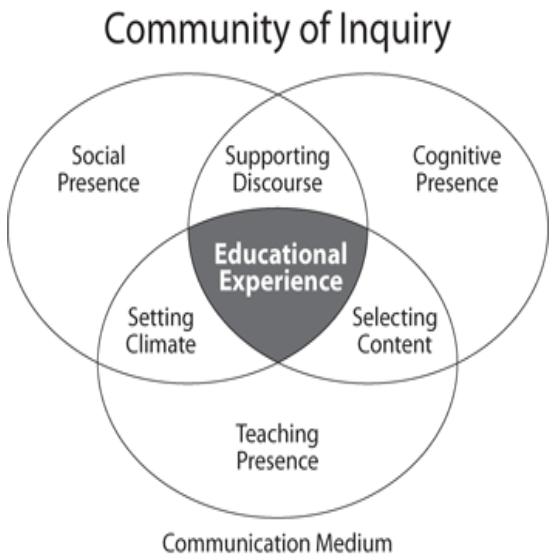
The CoI website describes the three interdependent elements as follows:
Social presence is “the ability of participants to identify with the community (e.g., course of study), communicate purposefully in a trusting environment, and develop inter-personal relationships by way of projecting their individual personalities” (Garrison, 2009, p. 352).
Garrison, Anderson, & Archer (2000)
Teaching Presence is the design, facilitation, and direction of cognitive and social processes for the purpose of realizing personally meaningful and educationally worthwhile learning outcomes (Anderson, Rourke, Garrison, & Archer, 2001).
Cognitive Presence is the extent to which learners are able to construct and confirm meaning through sustained reflection and discourse (Garrison, Anderson, & Archer, 2001).
This provides great insight for how I need to consider my actions and presence as a future -and current- teacher. It suggests that I need to foster the social, teaching, and cognitive presences of my students but also reflect that in my own instruction. I expect that this will need to be more deeply addressed in developing a community within the classroom: one that fosters meaningful connections and learning experiences that invest in the students’ interests.
I have much more to explore on the website and theory and feel I have only scratched the surface. Please feel free to share your perspectives in a comment!
References:
Garrison, D. R., Anderson, T., & Archer, W. (2000). Critical inquiry in a text-based environment: Computer conferencing in higher education model. The Internet and Higher Education, 2(2-3), 87-105.
Conrad, D., & Openo, J. (2018). Assessment strategies for online learning: Engagement and authenticity. AU Press. https://doi.org/10.15215/aupress/9781771992329.01
Such a great rundown of the 3 main elements! I totally get the concern of passing your assessment anxieties on to your students. I found that repositioning myself into more of a CoI viewpoint really helped me take a step back and recognize how I want to engage meaningfully with my own coursework, as well as how I want to engage meaningfully with learners rather than focusing all my energy into panicking over assessments. Thanks for this awesome post!
Hi Hanne! Great post! I can totally relate to your feelings of anxiety towards assessment. I also have felt the same sense of nervousness that I will allow this to be passed on to my students. More than anything, I want my class to be a space where my students feel comfortable and safe. For many, simply the word “assessment” is enough to take that feeling of comfort away. I love that you included the Venn diagram illustrating the different interdependent elements. I wonder what the best strategies for developing my competencies in relation to these elements would be? I want to be the best version of myself so that I can benefit my students in the best way that I can. Thanks for sharing!